
Keywords
Categories
How to Cite
Abstract
Editorial
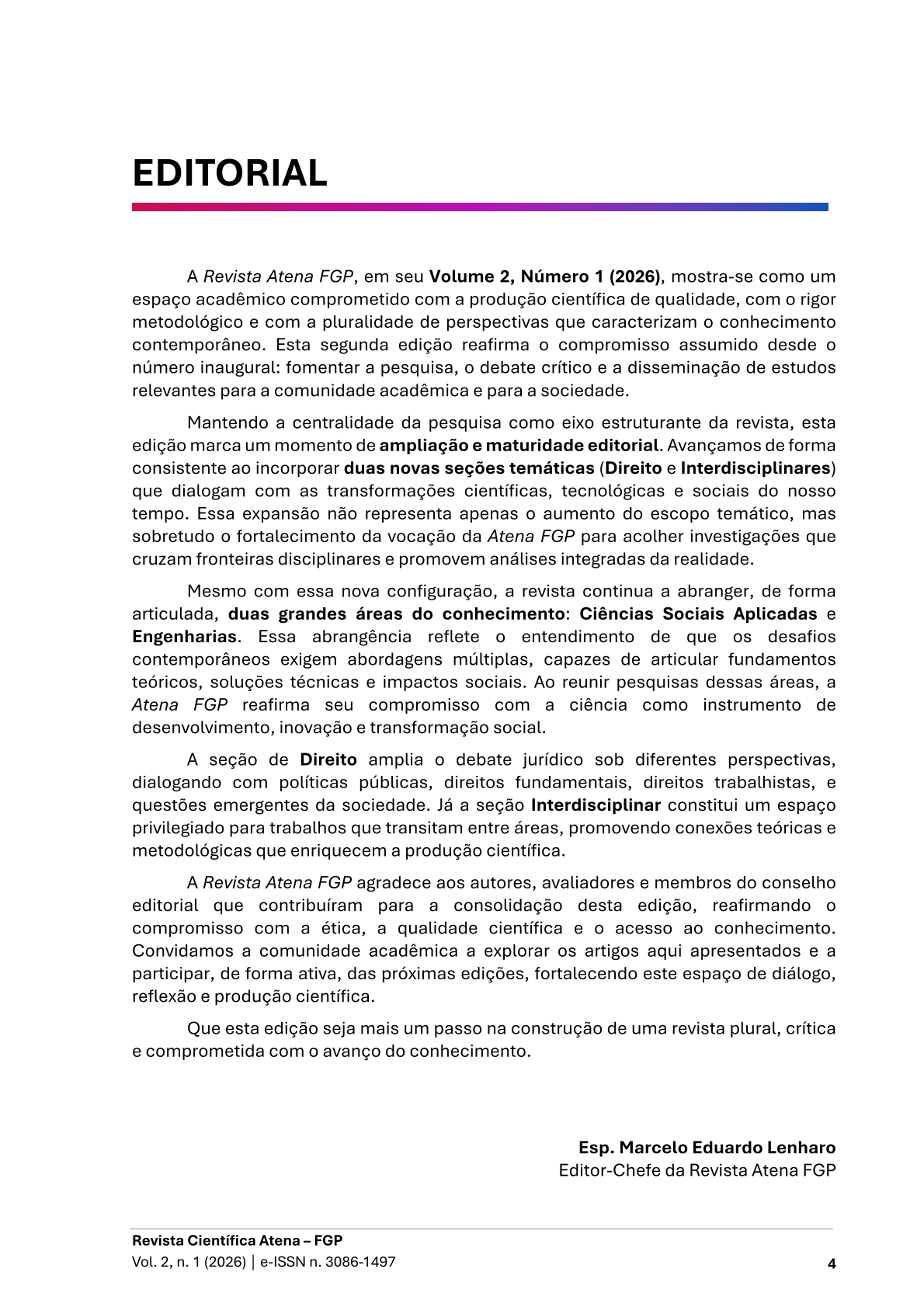
The Atena FGP Journal, in its Volume 2, Number 1 (2026), stands as an academic space committed to high-quality scientific production, methodological rigor, and the plurality of perspectives that characterize contemporary knowledge. This second edition reaffirms the commitment established since the inaugural issue: to foster research, critical debate, and the dissemination of studies that are relevant both to the academic community and to society.
Maintaining research as the structuring axis of the journal, this edition represents a moment of editorial expansion and maturation. We move forward consistently by incorporating two new thematic sections—Law and Interdisciplinary Studies—which engage with the scientific, technological, and social transformations of our time. This expansion represents not merely an increase in thematic scope, but, above all, the strengthening of Atena FGP’s vocation to welcome investigations that cross disciplinary boundaries and promote integrated analyses of reality.
Even with this new configuration, the journal continues to cover, in an articulated manner, two major areas of knowledge: Applied Social Sciences and Engineering. This scope reflects the understanding that contemporary challenges require multiple approaches capable of integrating theoretical foundations, technical solutions, and social impacts. By bringing together research from these areas, Atena FGP reaffirms its commitment to science as an instrument for development, innovation, and social transformation.
The Law section broadens legal debate from different perspectives, engaging with public policies, fundamental rights, labor rights, and emerging issues in society. The Interdisciplinary section, in turn, provides a privileged space for studies that move across fields of knowledge, promoting theoretical and methodological connections that enrich scientific production.
The Atena FGP Journal thanks the authors, reviewers, and members of the editorial board who contributed to the consolidation of this edition, reaffirming its commitment to ethics, scientific quality, and open access to knowledge. We invite the academic community to explore the articles presented here and to actively participate in upcoming issues, strengthening this space for dialogue, reflection, and scientific production.
May this edition represent another step in building a plural, critical journal committed to the advancement of knowledge.
References
-

This work is licensed under a Creative Commons Attribution-NonCommercial 4.0 International License.
Copyright (c) 2026 Esp. Marcelo Eduardo Lenharo (Autor)